reader 3.28 released – slow down, no AI redux
November 2026 ∙ three minute read ∙
Hi there!
I'm happy to announce version 3.28 of reader, a Python feed reader library.
What's new? #
Here are the highlights since reader 3.26.
Slow down on errors and not modified feeds #
reader now slows down on errors by increasing the update delay exponentially, and matches the rhythm of the feed by adjusting the delay based on when the feed was last modified,1 in addition to the HTTP hint support added in previous versions.
This is part of a larger story about being polite to servers. Here, we still need logic to change feeds permanently in some cases, e.g. to handle permanent redirects, persistent errors, and repeated throttling. reader now stores detailed metadata about the last few updates of each feed, which will allow doing so in a future plugin.
New contributors #
Thank you to the new contributors that submitted pull requests to these releases!
Notably,
you can now prevent automatic migrations
by passing migrate=False to make_reader()
or the equivalent CLI flag,
and you can filter entries added_before a specific time
(useful for
a main page that updates only once a day,
to prevent you from checking your feeds endlessly).
Want to contribute? Check out the docs and the roadmap.
Project infrastructure #
Earlier this year I added an AI policy banning LLM-generated content. To support it, there's now a pull request template asking contributors to confirm the PR does not contain any such content, and the readme mentions "no AI" as a deterrent.
reader stopped vendoring feedparser in 3.27, and recommends installing it from GitHub if you still want to benefit from the unreleased memory usage improvements.
Finally, Github Actions versions are now pinned and checked during CI.
Python versions #
reader 3.27 added support for Python 3.15 and PyPy 3.12, and dropped Python 3.11.
Hosted reader status update #
Speaking of, did I tell you I'm working on a hosted version of reader? :D
See also
- Why another feed reader web app?
- Why not just self-host it?
- Public demo (no login needed).
Not a lot of progress since last time, because I got distracted with the pyinfra live demo, and with making sure multi-user feed updates continue to work with the upcoming feed reader behavior plugin.
That's it for now. For more details, see the full changelog.
Learned something new today? Share it with others, it really helps!
What is reader? #
reader takes care of the core functionality required by a feed reader, so you can focus on what makes yours different.
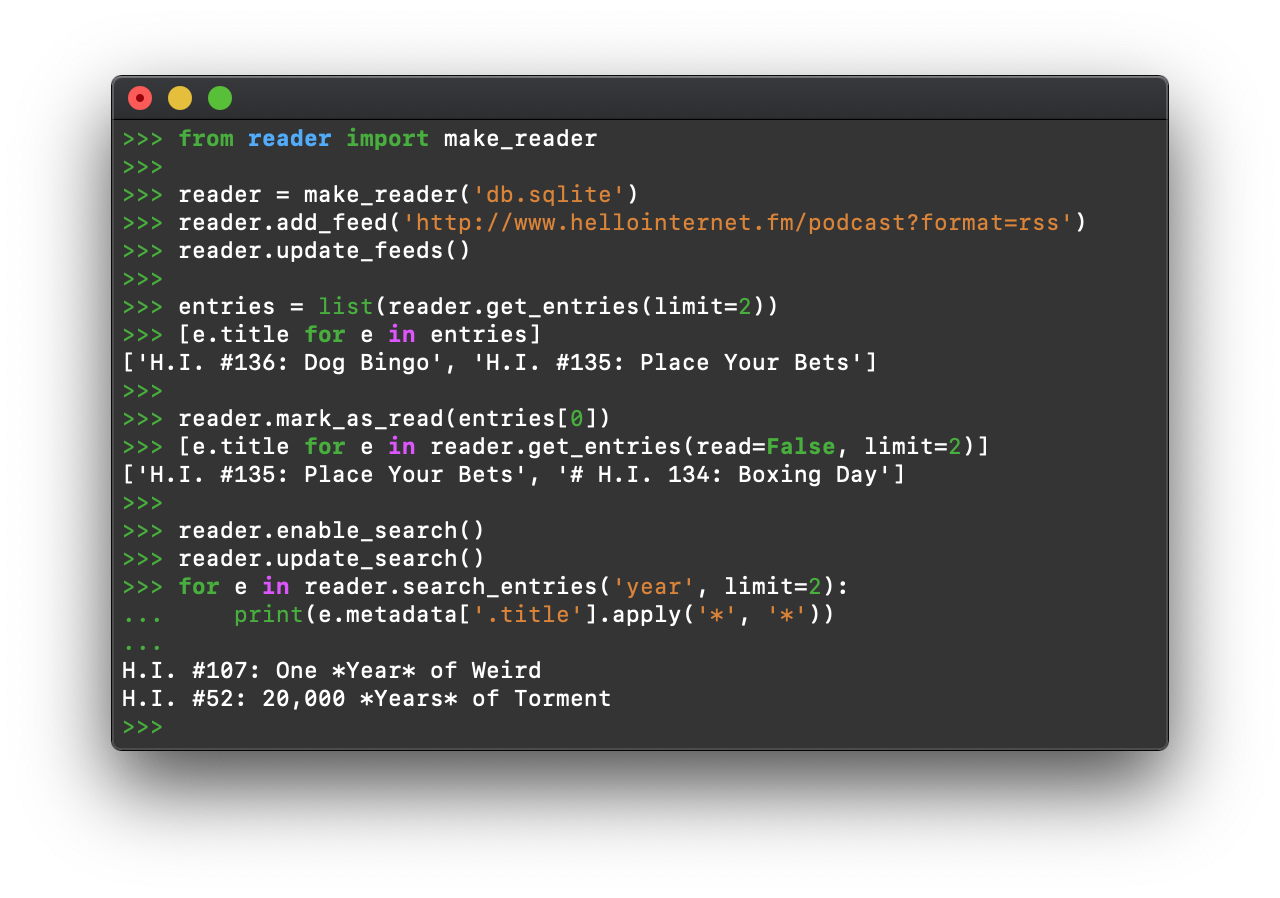 reader allows you to:
- retrieve, store, and manage Atom, RSS, and JSON feeds
- mark articles as read or important
- add arbitrary tags/metadata to feeds and articles
- filter feeds and articles
- full-text search articles
- get statistics on feed and user activity
- import / export feeds as OPML
- automatically discover feeds in web pages
- write plugins to extend its functionality
...all these with:
- a stable, clearly documented API
- excellent test coverage
- fully typed Python
...and with no AI.
To find out more, check out the GitHub repo and the docs, or give the tutorial a try.
Why use a feed reader library? #
Have you been unhappy with existing feed readers and wanted to make your own, but:
- never knew where to start?
- it seemed like too much work?
- you don't like writing backend code?
Are you already working with feedparser, but:
- want an easier way to store, filter, sort and search feeds and entries?
- want to get back type-annotated objects instead of dicts?
- want to restrict or deny file-system access?
- want to change the way feeds are retrieved by using Requests?
- want to also support JSON Feed?
- want to support custom information sources?
... while still supporting all the feed types feedparser does?
If you answered yes to any of the above, reader can help.
The reader philosophy #
- reader is a library
- reader is for the long term
- reader is extensible
- reader is stable (within reason)
- reader is simple to use; API matters
- reader features work well together
- reader is tested
- reader is documented
- reader has minimal dependencies
Similar to RFC 9111 heuristic freshness. [return]